Contact Number
- +91 9717548930
- Mon - Sat: 10.00 to 07.00
Enquire? Send Your Mail

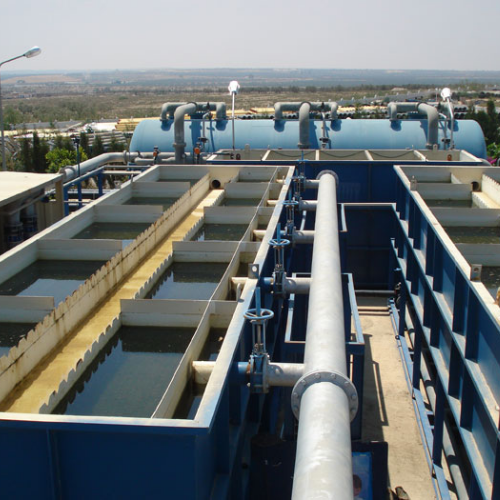
Surface Water Clarification
- Removes suspended solids and turbidity effectively
- Improves water clarity and transparency
- Uses coagulation and flocculation processes
- Reduces organic impurities and color
- Suitable for rivers, lakes, and reservoirs
- Enhances efficiency of downstream filtration
- Chemical dosing for better particle removal
- Handles high turbidity variations
- Scalable for small to large treatment plants
- Ensures consistent and reliable water quality
Surface Water Clarification is a critical process in water treatment systems designed to remove suspended particles, turbidity, and impurities from water sources such as rivers, lakes, and reservoirs. These natural water bodies often contain high levels of silt, organic matter, algae, and other contaminants that can affect water quality and make it unsuitable for direct use. Clarification plays a vital role in improving water clarity and preparing it for further purification stages.
The clarification process typically begins with the addition of coagulants such as alum or iron salts to the raw water. These chemicals help destabilize fine suspended particles that do not settle easily on their own. Once destabilized, the particles begin to clump together in a process known as flocculation. During flocculation, gentle mixing allows these small particles to combine into larger, heavier clusters called flocs.
Following flocculation, the water enters a clarification tank or sedimentation basin. In this stage, gravity allows the flocs to settle at the bottom of the tank, forming a layer of sludge. The clarified water, now free from most suspended solids, flows out from the top of the tank for further treatment. This process significantly reduces turbidity and improves the overall appearance and quality of the water.

