Contact Number
- +91 9717548930
- Mon - Sat: 10.00 to 07.00
Enquire? Send Your Mail


Softening Plants
- Removes hardness-causing minerals (calcium & magnesium)
- Prevents scale formation in pipes and equipment
- Improves water quality for domestic and industrial use
- Enhances efficiency of appliances and systems
- Uses ion-exchange resin technology
- Reduces soap and detergent consumption
- Provides consistent soft water output
- Easy to operate and maintain
- Suitable for residential, commercial, and industrial applications
- Increases lifespan of plumbing and machinery
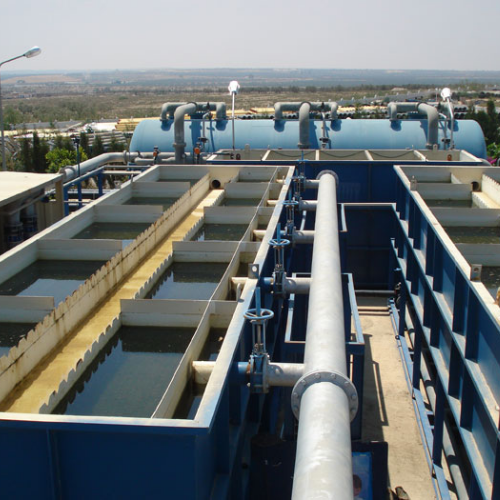
Softening Plants are specialized water treatment systems designed to remove hardness-causing minerals such as calcium and magnesium from water. Hard water is a common issue in many regions and can lead to scale formation, reduced efficiency of appliances, and increased maintenance costs. Softening plants provide an effective solution by converting hard water into soft water, making it suitable for domestic, commercial, and industrial applications.
The core principle behind water softening is the ion-exchange process. In this process, hard water passes through a resin bed containing sodium ions. The resin attracts and binds calcium and magnesium ions present in the water and replaces them with sodium ions. This exchange effectively removes hardness and produces soft water. The treated water is then suitable for use in various applications such as washing, cleaning, and industrial processes.
One of the major advantages of softening plants is their ability to prevent scale formation. Scale deposits caused by hard water can accumulate on the inner surfaces of pipes, boilers, and heat exchangers. These deposits reduce heat transfer efficiency, increase energy consumption, and can lead to equipment failure over time. By removing hardness, softening plants protect equipment and improve overall system performance.